Why I like working as a Project Manager: 6 reasons to start this career
Is it worth pursuing a career in project management? See 6 reasons why I like being a Project Manager and how to get started in the field.
Is it worth pursuing a career in project management? If you're just starting out, chances are your search for that answer has led you to a pile of acronyms, certifications, methodologies and tools. The first time I heard about project management was in my 6th semester of college. It feels like there's a huge list of things to master before you even take the first step.
After a few years in the profession, my answer is yes. But the reason probably isn't on the list you found.
Managing a project involves methods, tools and controls. You'll need them, and they help a lot. But what really matters is leading change. In practice, the project manager is a change leader: they take a current situation, help people get to a new one, and make sure that crossing actually happens.
That's what makes me like the profession. I've picked out six points that explain why.
1. Every project brings a different challenge
There's work where you repeat the same routine for months. In projects, that almost never happens. A project can be rolling out a system, opening up an operation, reorganizing a process, or delivering a new product. Each one has a different scope, deadline, budget and people.
Even when the type of project repeats, the context changes. The team is different, the urgency is different, leadership support is different. What worked last time serves as a reference, but rarely works as a ready-made recipe.
For someone just starting out, this can be scary at first. Over time, it becomes the reason the work never gets monotonous. I wake up knowing I'll be dealing with a problem I haven't solved the same way before. Even though it's stressful, it's also motivating.
2. You interact with people from different areas, sectors and industries
A project manager rarely works in isolation. On a single project, I might talk to the people running day-to-day operations, finance, the technology team, legal, and senior leadership. Each one sees the project from a different angle and has their own language.
That contact is one of the parts I enjoy most. I learn how each area thinks, what it values and where it feels pain. When the project crosses companies or sectors, that exchange gets even bigger.
This is also where the profession asks the most of us as people. Translating one area's need into another's, aligning expectations and building trust are skills that develop in practice, conversation after conversation.
3. We're driven by change and by the small legacies we leave behind
A project exists to change something. When it ends, something is different: a new revenue line, a lower cost, a happier person, group or community, an improvement in operational efficiency, a more organized area, a delivery that used to take weeks and now takes days.
I like to think of these as small legacies. They're rarely big or famous things. Often they're improvements that almost no one outside notices, but that change the routine of whoever uses them. A team that started working with more clarity, or a customer who started being served better, are already reason enough for me to consider the effort worthwhile. It's not a lack of ambition, it's recognizing that small changes have value too.
A simple example: a process that depended on several spreadsheets and scattered messages starts having a defined flow, with clear owners. No one's going to throw a party over it. But months later, you find someone on the team working with less rework and less anxiety, and you understand that project created value. Big projects tend to leave big legacies (and big disappointments too); small projects fill you with the confidence to raise the bar.
When you look back and can point to what you left better than you found it, the exhaustion of a hard project weighs less.
4. You expand your knowledge in areas that aren't your specialty
You don't need to be an expert in every subject to manage projects. But you do need to understand enough about each area involved to ask good questions, assess risks and support decisions.
That's led me to learn about topics I never imagined studying when I started: operational processes, contracts, financial metrics, technologies across different areas, people management. Each project ends up being a small practical class, with teachers who know the subject up close.
When an expert explains why a certain decision is risky, or how an area really works on the inside, you learn something no course delivers the same way. Over time, that scattered knowledge turns into a more complete view of the business, and that helps you connect the dots and make better decisions, even outside the project.
For someone just starting out, this is a good part of the career. You don't have to pick a single specialty now. The work keeps expanding your repertoire, and that repertoire increases your ability to contribute.
5. The visibility the role gives you
The project manager tends to be in the middle of the important conversations. They present results, report risks, take part in decisions and talk to the people making decisions in the organization. That gives you exposure.
Is that operational? Yes. But I see it as an opportunity, and also as a responsibility. Visibility opens doors, brings you closer to people you might not otherwise meet, and shows the value of your work. On the other hand, when something goes wrong, that's also evident. Learning to handle that spotlight is part of professional growth.
If you want to grow and be noticed for what you deliver, managing projects gives you a good stage for that.
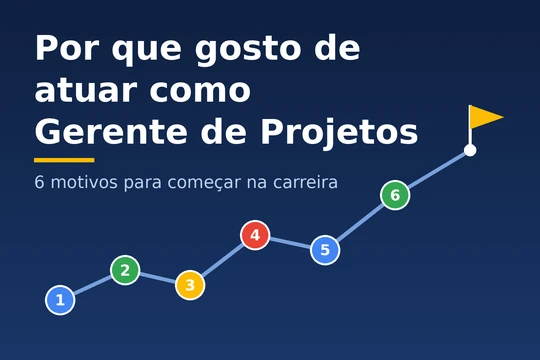
6. The journey is like a championship
Projects work like a game. The intermediate deliveries are the stages. The risks and surprises are the obstacles. The lessons learned stay with you for the next challenge.
And here's what I most want you to take from this piece: the pleasure is in the journey. When we play a game, few people want to skip straight to the final. The fun is in playing, and the same goes for the project. The final delivery matters, of course, but a big part of the satisfaction comes from the path: the people you met, the problems you solved, and how you were at the start versus how you are now.
If you only look at delivery day, the career will feel heavy. If you learn to enjoy each stage, it becomes much lighter.
That doesn't mean ignoring the difficulties. There are phases when the deadline tightens, the budget disappears, or a key person leaves the project. But, like in a game, those are the moments you learn the most from. Each stage you get past leaves you more experienced for the next one, and that growth is what gives the path meaning.
How to start a career as a project manager
If you're thinking about entering the field, you don't need to master every method before you start. Learn the basics, practice on small projects and ask for feedback. The tools and controls you'll learn along the way.
Take advantage of small opportunities: organizing an event, coordinating an improvement in your area, shadowing a project alongside someone more experienced. These are real projects, and each one teaches you something about deadlines, people and change.
What's worth developing from day one is the posture of a change leader: proactivity, a willingness to connect with different people, and the drive to leave things a little better than you found them.
These are some of the reasons I like working as a project manager. And you, what do you expect from this career? Tell me in the comments.
If you want to keep reading, also check out: How do you encourage people to collaborate on your projects?
Note: this text reflects my personal views and doesn't represent any specific company.
Leandro | PMP | Project and Portfolio Manager